
Colorado's Unified Clerk Structure
The Colorado Judicial Branch reports a Clerk of Court in each of the state's 64 counties. One state-court clerk organization supports both District Court and County Court case files rather than dividing them between separately elected district and county trial-court clerks. Large courthouses may have civil, criminal, domestic, probate, or records counters. Rural counties may share judges within a judicial district. In both settings, the case remains with the clerk in its county of filing.
Denver is the operational exception that proves the rule. Its constitutionally separate District, Juvenile, Probate, and County Courts have distinct contacts and locations. Elsewhere, combined administration is common, but a requester must still identify the case class and court. Colorado clerks accept and timestamp papers, index filings, maintain the register of actions and exhibits, record docket activity, collect court money, retrieve archives, and issue authenticated copies. They provide process information but cannot give legal advice.
Colorado Clerk of Court Records
The Clerk of Court is the legal custodian for filed state-court material. That includes unlimited civil actions, felonies, divorce and custody proceedings, juvenile and probate cases in District Court, plus misdemeanors, traffic infractions, small claims, evictions, protection orders, and limited civil cases in County Court. A municipal ordinance file stays with the city court instead. Appellate files are held by the appellate clerk, and federal files belong to the federal court.
The elected county clerk and recorder has a separate public role. That office issues and records marriage or civil-union licenses and maintains real-property, election, and recording records. A marriage license therefore goes to the recorder, while a divorce decree goes to the District Court Clerk. Probate pleadings also go to the Judicial Branch Clerk of Court even when estate property creates a separate recorded deed.
- District civil, felony, domestic relations, probate, juvenile, and mental-health case files
- County civil, misdemeanor, traffic, small-claims, eviction, and protection-order files
- Registers of actions, filed pleadings, signed orders, judgments, and exhibits
- Certified or exemplified court copies and archived-file retrieval
- Filing-fee, fine, restitution, and other court-account transactions
Clerk of Court Records and Duties
Colorado uses one state trial-court clerk structure, so the useful comparison is by task. The table identifies which duties belong to the Clerk of Court and flags records that must go elsewhere.
| Record or duty | Colorado custodian or action |
|---|---|
| Felony, civil, divorce, probate, or juvenile case | District Court Clerk in the filing county |
| Misdemeanor, state traffic, small claims, or eviction | County Court Clerk in the filing county |
| Official register, pleading, order, or judgment | Clerk of Court, not a search vendor |
| Marriage or civil-union license | Elected county clerk and recorder |
| Deed or land recording | Elected county clerk and recorder |
| City ordinance or municipal ticket | Named municipal court clerk |
| Federal or bankruptcy case | Appropriate federal court clerk |
A case calendar found through the free Docket Search is not the official court file. Commercial register vendors can provide unofficial, real-time register data for many state trial cases, but they do not supply official document copies. The filing clerk is the final source.
Access Colorado Clerk Records
Colorado provides several access channels. The free Docket Search can locate scheduled hearings. The Judicial Branch's e-filing and register-vendor page distinguishes electronic filing from paid public register access. The Record/Document Request routes copy requests to a selected court. A requester may also visit, mail, telephone, or email the local clerk when that court permits the channel.
In-person review is often best for confirming the official register, identifying an archived file, or asking which public material can be inspected. Older records may be offsite or transferred to the Colorado State Archives. Probate indexing does not reach before 1988, so those files require direct county research. Administrative records about branch operations follow Judicial Branch administrative-record policy. A generic open-records request to a county office is not a substitute for a court-file request.
Note: A clerk can explain filing and copy procedure, but cannot choose a form, interpret an order, or advise a legal strategy.
Request Certified Colorado Court Copies
Certification authenticates a filed document. Courts, agencies, banks, title professionals, and other recipients may require it, while a plain emailed copy may be enough for personal review. Ask the receiving organization what form it needs before paying. Certification is assessed per document, so a broad request for every paper can cost far more than a request for one final decree or disposition.
- Identify the filing county, court type, and exact document needed.
- Find the case number through a known paper, docket result, register, or focused name search.
- Submit the statewide web form or use the local clerk's accepted in-person, mail, email, or telephone process.
- State whether a plain, certified, or exemplified copy is required and request a written estimate.
- Pay by the method the clerk confirms, then arrange delivery or pickup.
The statewide form says the ordinary response target is within three business days absent extenuating circumstances. That is not a promise that every archived, reviewed, or certified file will arrive within three days. Retrieval, redaction, page count, and mail can add time.
Colorado Record Request Fields
A narrow request helps the clerk locate the right case and avoids unnecessary search or research charges. Complete the routing fields for the court where the matter was filed, not the requester's present county.
| Field | How it helps |
|---|---|
| Requester name, business, email, phone, and address | Provides identity, response, and delivery information |
| Court, judicial district, and county | Routes the request to the legal custodian |
| Case number | Avoids a name search when known |
| Party names and filing year | Narrows a name-only search |
| Document choice | Selects a disposition, order, ticket, judgment, satisfaction, probate paper, or ROA |
| Date of death | Helps distinguish probate estates |
| Certification or exemplification | States the required authentication level |
For probate, the form offers Letters, Will, Trust, Application, Petition, Closing, and Claims. Criminal choices include a disposition or sentence order, protection order, and ticket. Civil choices include judgment orders, transcripts of judgment, satisfaction documents, and protection orders. Free text can identify another precise document.
Colorado Clerk Copy Fees
The official Colorado court fee list supplies the current statewide figures. The same source pictured below helps distinguish filing charges from record-copy charges.
View the Colorado Judicial Branch fee source used for court charges.
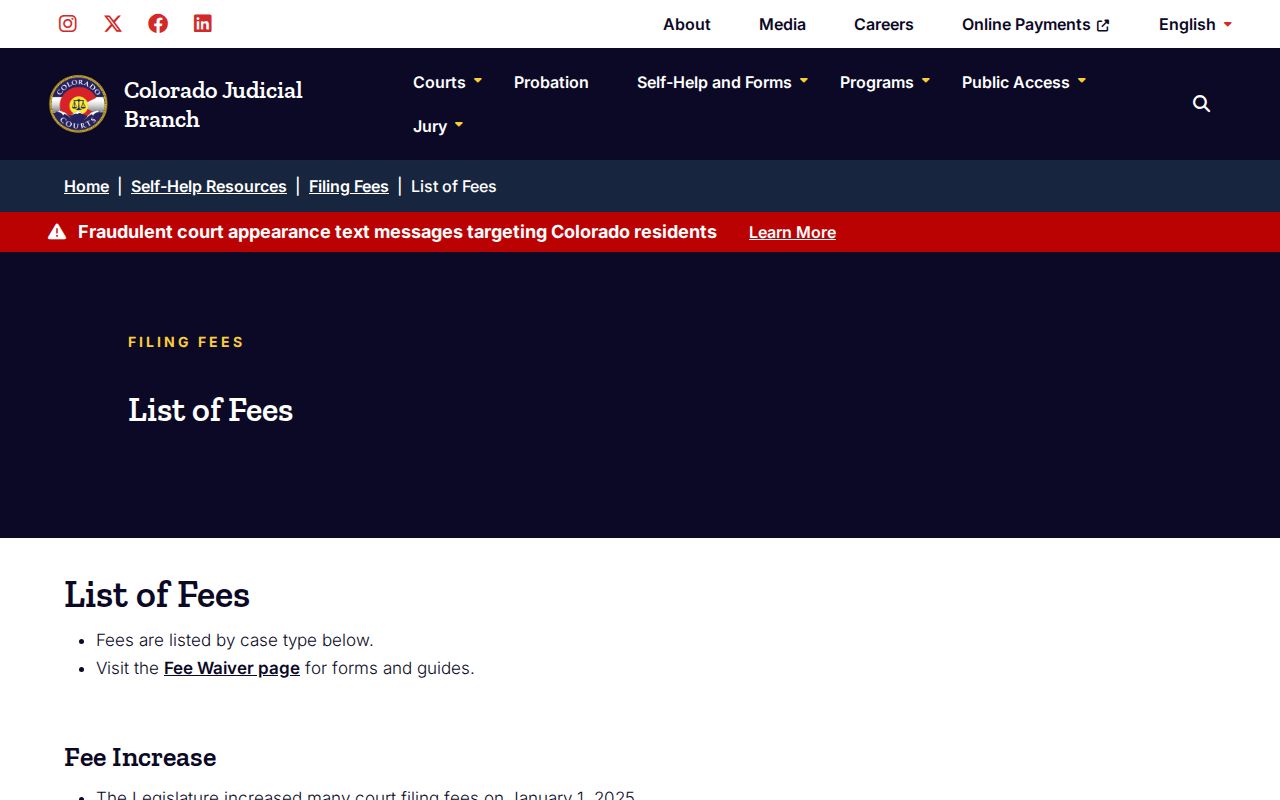
The fee page is the right place to confirm a current amount before filing or ordering copies.
| Clerk service | Current amount or rule |
|---|---|
| Plain copy | $0.25 per page |
| Party or attorney page-copy maximum | $15; no such cap for nonparties |
| Certified or exemplified copy | $20 per document |
| Name search | $5 |
| Transcript of judgment | $25 |
| Certificate of satisfaction | $20 |
| Research or redaction | $30 per hour after the first hour, billed in quarter hours |
| Offsite retrieval | Actual cost |
Postage, vendor access, transcripts, card service, and local service costs may be separate. The Judicial Branch fee-waiver process can address qualifying court charges, but a waiver does not automatically cover a commercial search, sheriff service, or other third-party charge.
Colorado E-Filing and Mail
Colorado Courts E-Filing is a filing channel, not a public copy repository. Attorneys use the prescribed electronic system, and self-represented parties may e-file supported case types after creating an account or may file at the counter. Mail requests should list party names, case number, exact document, requested authentication, return contact, and payment method as directed. Never mail an assumed amount when the page count or retrieval status is unknown.
State and federal clerk systems are separate. The U.S. Bankruptcy Court for the District of Colorado image below represents a federal clerk source, which does not hold Colorado District or County Court files.
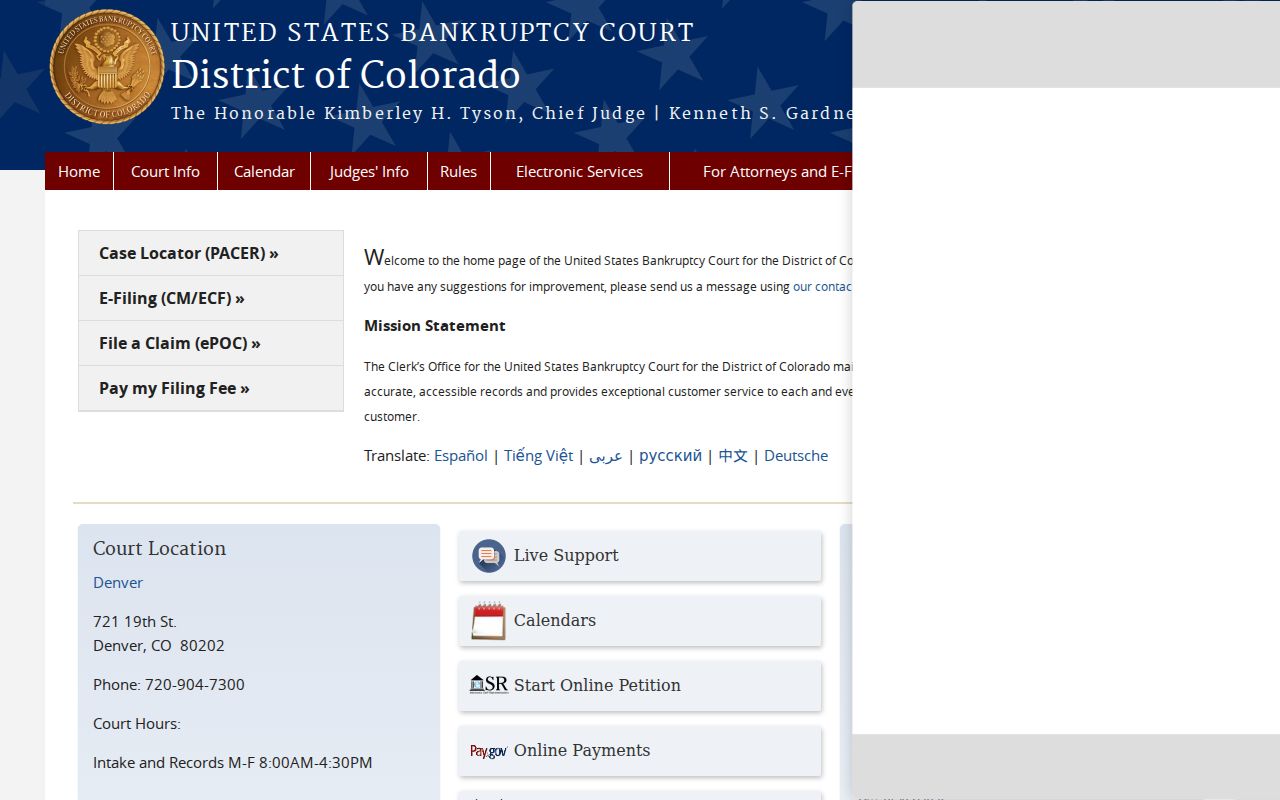
Federal bankruptcy records must be requested through the federal court or PACER, while state cases remain with Colorado Judicial Branch clerks.
Find Any Colorado Court Clerk
Every Colorado county has a Clerk of Court, but contacts, counters, hours, and accepted request channels differ. Browse the full directory of all 64 Colorado counties, select the filing county, and then confirm the state court and division. For a marriage license or deed, switch to that county's clerk and recorder. For a city ticket, use the municipal court printed on the citation.
Start with the legal custodian, then ask for the register of actions before ordering a large file. That sequence limits delay, avoids an unnecessary name-search charge when a case number can be found, and gives the clerk a precise list of documents to copy.