
Colorado Records: Which Office?
Colorado uses three clearly different roles. The elected county clerk and recorder issues and records the marriage license. The state-court Clerk of Court keeps the district-court divorce case and decree. The Colorado Department of Public Health and Environment Vital Records provides statewide vital-record guidance and expressly routes marriage requests to county recorders and divorce, separation, and annulment requests to district courts. CDPHE is not a substitute certificate custodian for these two records.
Quick Reference:
New or recorded marriage license: County clerk and recorder in the issuing county.
Certified marriage copy: County clerk and recorder that issued and recorded the license.
Divorce case and decree: Judicial Branch Clerk of Court in the district court where filed.
State guidance: CDPHE Vital Records routes the requester to the correct local custodian.
| Record | Original Issuing / Filing Office | Certified Copy Source |
|---|---|---|
| Marriage license | County clerk and recorder where obtained | Same issuing and recording county |
| Recorded marriage certificate | County clerk and recorder after return | Same recording county |
| Divorce petition and case file | District-court Clerk of Court where filed | Same filing court |
| Divorce decree | District-court Clerk of Court where filed | Same filing court |
| Historic transferred record | Original county or Colorado State Archives | Current legal custodian confirms certification |
Colorado Marriage License Rules
Apply through a Colorado county clerk and recorder. County preapplication, appointment, identification, payment, and return practices vary. Colorado generally has no waiting period, and a Colorado license can be used statewide. It normally must be solemnized and returned for recording within 35 days. The issuing county remains the records custodian even if residence or ceremony took place elsewhere.
Colorado permits authorized solemnization and self-solemnization. Proxy marriage is limited to statutory conditions. A person under 18 needs judicial approval using the statewide petition and order process. Prior marital or civil-union status and termination details are part of the application. Confirm the current county instructions before appearing.
Apply for a Colorado License
Choose the issuing county first because that recorder will later certify the recorded license. Use the county's official application instructions rather than assuming another county's appointment or ID rules apply.
- Choose a county clerk and recorder through the Colorado county directory.
- Complete any county preapplication and make an appointment if that office requires one.
- Gather legal names, birth and residence facts, parent details, prior-union termination facts, identification, and any underage or proxy order.
- Appear and sign or swear as the recorder's current process requires, then pay the county's posted fee.
- Review the issue date, expiration or return deadline, names, and solemnization method before leaving.
- Complete the ceremony or lawful self-solemnization and return the signed license to the issuing recorder within the required period.
- After recording, order certified copies from that same county when needed.
Marriage License Application Fields
Colorado county forms vary, but the application commonly collects these field families. Social Security numbers and other protected identifiers should be supplied only through the recorder's secure process.
| Field | Required | Notes |
|---|---|---|
| Full legal and post-marriage names | Form dependent | Match identity documents and county naming fields. |
| Birth date and birthplace | Yes | Collected for each applicant. |
| Residence and mailing address | Yes | City, county, and state fields may be separate. |
| Social Security number | Confidential field | Provide only through the recorder's official process. |
| Prior marriage or civil union | Yes when applicable | Status plus manner, date, and place the last union ended. |
| Parents' birth names and birthplaces | Form dependent | Historical and identity fields. |
| Solemnization and signatures | Yes | Includes parties, ceremony date and place, and officiant or self-solemnization certification. |
Colorado Marriage and Divorce Fees
Marriage license and certified-copy charges must be confirmed with the issuing county recorder. The current statewide Judicial Branch list shows $260 for a divorce, legal-separation, invalidity, or declaratory petition. An older fee sheet may show $230, so the live list controls. Court-copy and certification costs are separate from the filing fee.
| Item | Amount | Where Paid |
|---|---|---|
| Marriage license | Confirm current county amount | County clerk and recorder |
| Certified marriage copy | Confirm current county amount | Issuing and recording county |
| Divorce or separation petition | $260 current statewide list | District-court Clerk of Court |
| Plain court copy | $0.25 per page | Filing court |
| Certified or exemplified court copy | $20 per document | Filing court; page and delivery charges may apply |
| Court name search | $5 | Filing court when case number is unknown |
Look Up Colorado Marriage Records
Search the county where the license was issued and recorded, which may differ from either person's home and from the ceremony location. Colorado licenses can be used statewide, and self-solemnization means ceremony assumptions are especially weak. Supply both parties' full names, maiden or prior names, approximate year, and possible issuing counties.
Ask for the recorded license or certificate and its index fields. A preapplication that was never completed and returned may not create the same record. Common-law marriage may have no license at all; its existence can instead arise in probate, benefits, domestic, or declaratory litigation. For transferred historical material, check the original recorder and Colorado State Archives.
Find Colorado Divorce Records
A divorce decree belongs to the district court where the dissolution was filed. Search likely filing counties and years under current, maiden, prior, hyphenated, and spouse names. Use the free statewide docket calendar for hearing clues, but request the register of actions and decree from the filing Clerk of Court through the Colorado county directory.
Colorado divorce files can include the petition, case information, summons and service, financial disclosures, parenting and support documents, agreements, orders, decree, and later enforcement or modification activity. The Judicial Branch divorce and legal-separation instructions provide the official statewide steps. Public access can exclude protected identifiers, child-abuse material, addresses, evaluations, and other confidential attachments. A legal separation decree does not end the marriage; a later conversion after the required period creates more filings.
Certified Colorado Record Copies
Order a certified marriage record from the county recorder that issued and recorded it. Order a certified divorce decree from the district-court clerk that entered it. Certification can matter for a name change, benefits, immigration, licensing, estate, or another court. An online index hit is not the certified instrument.
- Decide whether the record is a marriage license or a judicial divorce decree.
- Identify the issuing recorder for marriage or filing district court for divorce.
- Gather full names and variants, event or filing year, county, license or case number, and requester details.
- Ask the custodian for its request form, identification rule, current fee, payment method, and delivery options.
- Submit the focused request and retain the receipt or order record.
For divorce, requesting the register of actions first can reveal the exact decree or later conversion order. For marriage, specify that the copy must be certified after recording.
Colorado Vital Records Guidance
CDPHE Vital Records is the statewide health-record office, and its certificate ordering guidance covers the certificates it actually issues. Its marriage and divorce guidance points users out to the local legal custodians. It does not offer the statewide marriage-and-divorce abstract system assumed by many generic record templates. Use CDPHE to confirm the official split, then order a marriage record from the county recorder or a divorce decree from the district court.
The CDPHE Vital Records page shown below is the official statewide entry point and routing source.
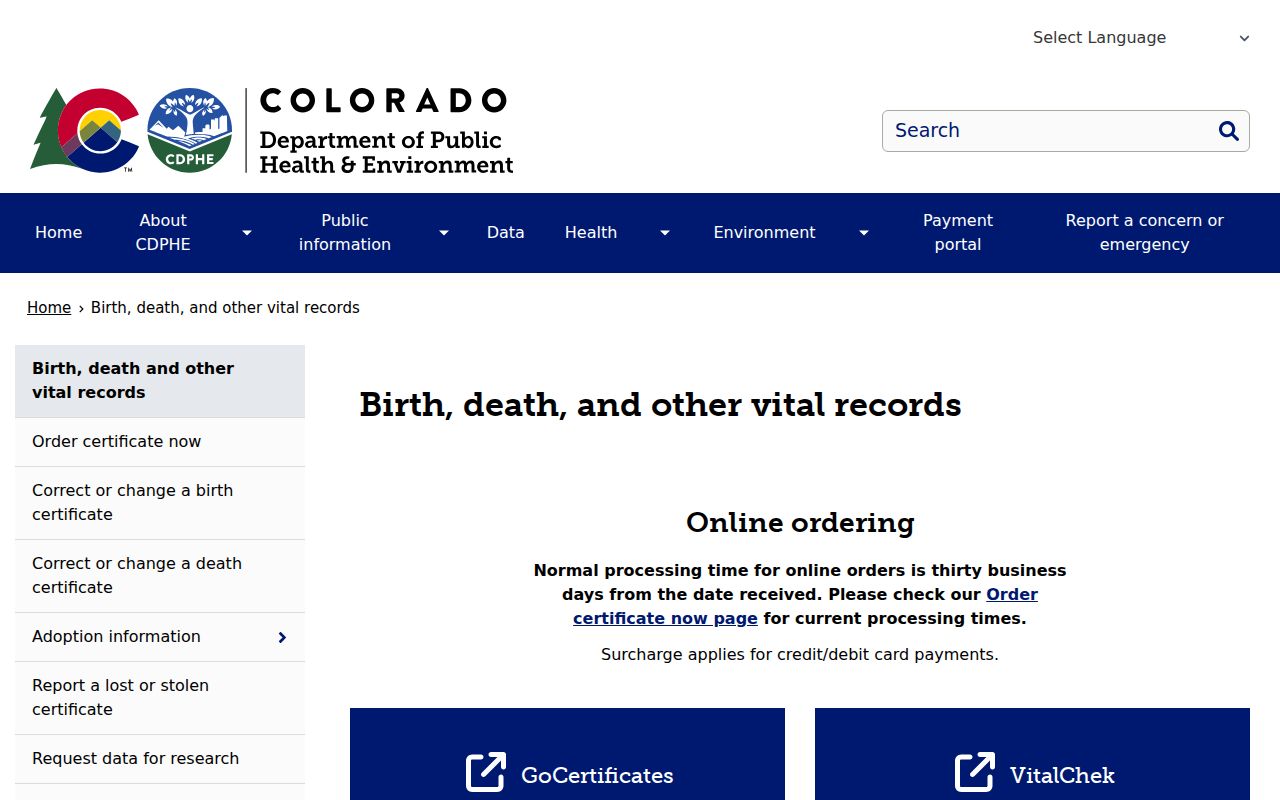
Its statewide role is guidance for these records, while the county and district court remain the source of the legal copy.
Vital Records vs. local custodian: CDPHE routes marriage to the issuing county recorder and divorce, separation, or annulment to the filing district court.
Colorado Department of Public Health and Environment
Vital Records guidance
Statewide routing for marriage and divorce custodians
Find Colorado Marriage or Divorce Offices
Colorado's 64 counties have county clerks and recorders for marriage licensing and Judicial Branch Clerks of Court for state cases. The names sound similar, but their records are not interchangeable. Browse the full Colorado county directory, choose the event or filing county, and then select the recorder for marriage or the district court for divorce.
The Colorado Judicial Branch divorce resource shown below illustrates the court route for petitions, forms, and decrees.
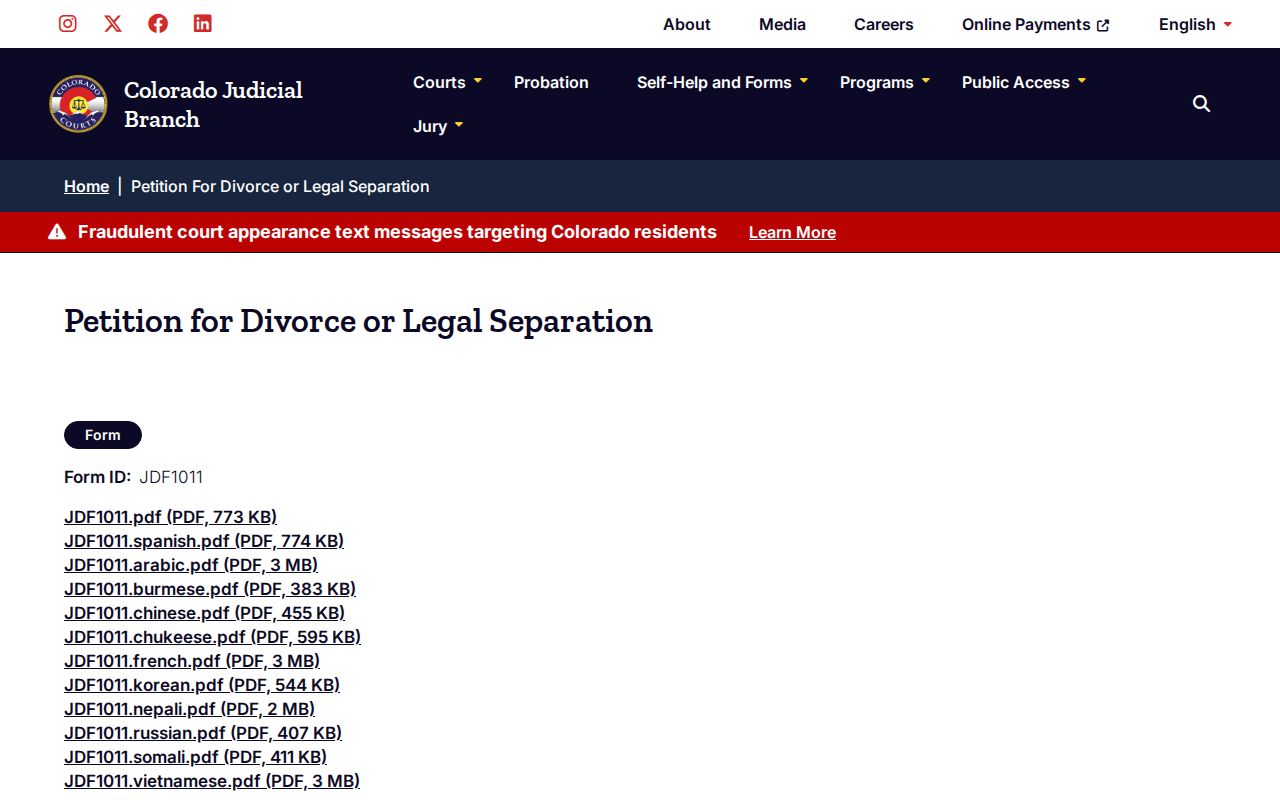
It confirms why a divorce decree must be requested from the judicial file rather than a county recorder.
Names can change through marriage or decree, so search maiden, prior, hyphenated, and spouse names. For old records, ask whether the county transferred holdings to Colorado State Archives. A common-law marriage may have no license record, and lack of a recorder result is not proof that no legal relationship existed.
Certification must come from the current legal custodian even when an online index or archive catalog helps locate the record.