
Understanding Colorado Court Dockets
Colorado uses related terms for different products. The free statewide Docket Search is a hearing calendar. It displays published settings and basic case identifiers. A register of actions, often shortened to ROA, is the chronological case-event index maintained by the Clerk of Court. The full case file contains the complaint, motion, exhibit, order, judgment, transcript, or other document named in those entries.
Clerks add entries as papers are accepted and events occur. A line may identify the filer, date, event title, and court action. Yet a short label can hide important detail. “Order Granted” does not disclose the full relief, and “Case Closed” does not establish who prevailed or whether money remains due. A scheduled hearing proves only that the calendar listed an event, not that it occurred. Read the register with signed orders when the result matters.
- Docket calendar
- A schedule of hearings with basic case and courtroom data.
- Register of actions
- The chronological index of filings, settings, orders, and case events.
- Case file
- The actual documents and eligible exhibits held by the filing court.
Find Colorado Court Dockets Online
The Colorado Judicial Branch Docket Search is free and covers state District and County Court hearing calendars. It excludes Municipal Courts. The search requires a date or date range plus another criterion. Users can narrow by judicial district, county, courthouse, court type, or division. Case searches separate the four-digit year, case class, and numeric sequence. Party searches offer Individual and Business modes, while attorney searches use a lawyer's name or bar number.
The official Colorado docket search image from the manifest illustrates the statewide filters.
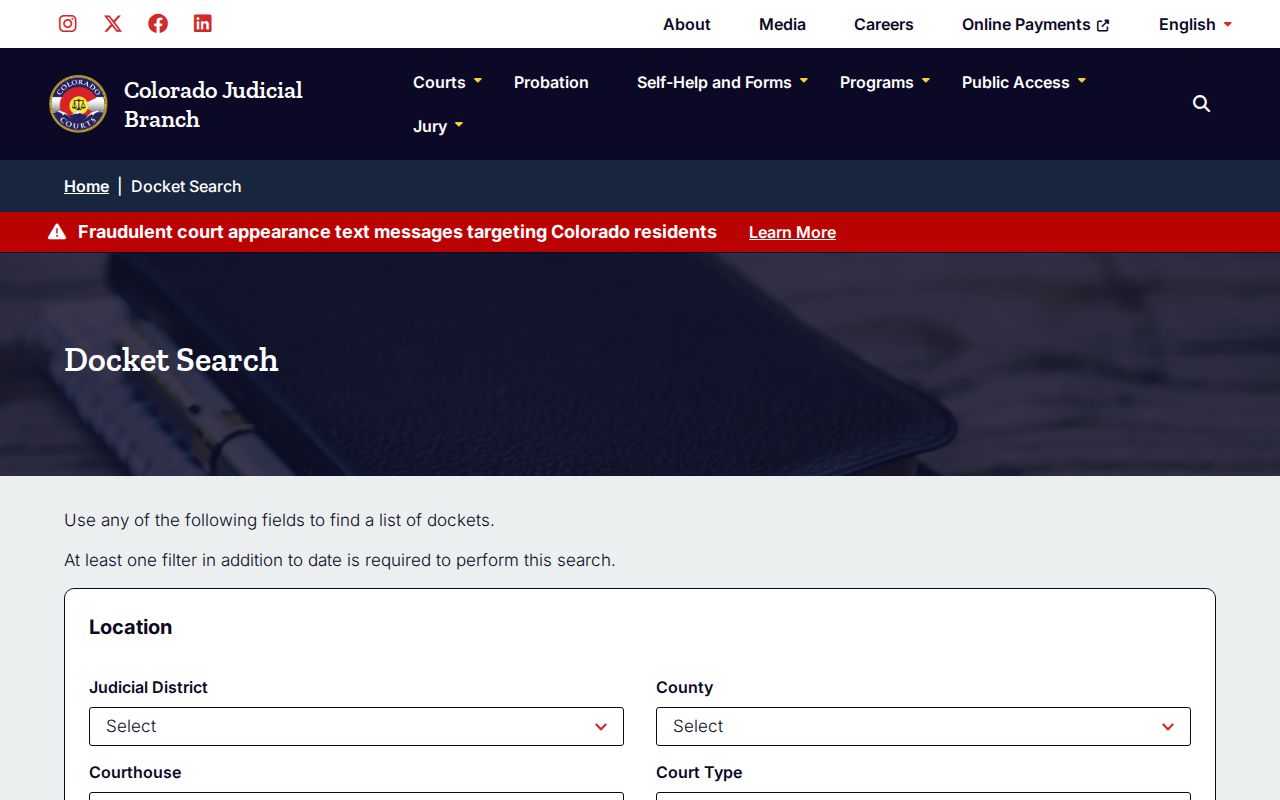
Those controls help route a request, but they do not replace the clerk's official Colorado docket or document file.
- Choose a date range that fits the likely hearing period, then add a location, case, party, or attorney filter.
- Use a full case number when possible. Otherwise search exact names, prior names, aliases, and business spelling variants.
- Review the listed date, time, duration, party, case number, hearing type, location, appearance type, and courtroom.
- Save the complete number and courthouse. Request the ROA or document from the filing clerk for an official result.
If nothing appears, change the time window and remove overly narrow location filters. The calendar is not an unrestricted all-years party index. A case with no published hearing may be absent even though an older register exists. Municipal, federal, sealed, and delayed entries require different checks.
Read Colorado Docket Results
A public Colorado calendar result identifies the scheduled event and its file. Research inspection found hearing date, start time, estimated duration, party name, case number, hearing type, location, appearance type when populated, and courtroom or division. Export and printable controls may appear. These fields do not supply charge detail, judgment PDFs, pleadings, a financial ledger, or a sentence.
| Field | Sample Value | What It Means |
|---|---|---|
| Case Number | 2026C39328 | The year, class, and sequence used to identify the state file. |
| Hearing Type | First Hearing | The event scheduled, not proof it occurred or produced a ruling. |
| Date and Time | Listed setting | Calendar data that should be confirmed with the current court notice. |
| Location | County / courthouse | The clerk and location tied to the scheduled event. |
| Appearance Type | May be blank | A blank value does not establish in-person or remote attendance. |
| Duration | Estimated minutes | An administrative estimate, not the actual length or outcome. |
Preserve the listed party spelling, location, and case number when contacting the clerk. A courthouse name can be more precise than a county label, especially when one judicial district serves several counties or a court has more than one location.
Colorado Courts in Docket Search
State District Courts and County Courts feed the Colorado Judicial Branch system. District cases include felony, unlimited civil, domestic relations, juvenile, probate, mental-health, and water matters. County Courts hear misdemeanor, state traffic, protection-order, eviction, small-claims, limited civil, and early felony proceedings. Coverage does not turn the calendar into the official record, and protected cases may be suppressed or limited.
Municipal Courts sit outside the state branch. A city ordinance or municipal traffic case may appear only through the issuing city's court or clerk. Denver also requires care because its District, Juvenile, Probate, and County Courts have separate operational contacts. The 23rd Judicial District, effective in 2025, covers Douglas, Elbert, and Lincoln Counties; older district references can misroute a search.
Note: Read the court named on a summons or citation before searching; a correct name in the wrong system can return nothing.
Colorado Docket Versus Case File
Three access levels answer different questions. The free calendar answers when and where a hearing is listed. An approved commercial register identifies indexed events in a state trial case, but the Judicial Branch calls vendor data unofficial. The filing clerk supplies the authoritative register and copies of pleadings, orders, judgments, wills, tickets, or dispositions. Transcripts, recordings, and eligible exhibits may require separate requests.
| Docket | Full Case Record | |
|---|---|---|
| Content | Calendar or event labels and basic metadata | Pleadings, signed orders, judgments, eligible exhibits, and filed material |
| Access | Free calendar or paid commercial register | Web request, mail, email where accepted, telephone inquiry, or inspection |
| Authority | Useful index; vendor register is unofficial | Official copies and certification come from the filing court |
| Best use | Locating court, event, number, and status clues | Proving actual terms, disposition, judgment, or sentence |
The Colorado Record/Document Request can request an ROA, disposition or sentence order, judgment, protection order, ticket, and named probate documents. It routes to a selected court. The ordinary response goal is within three business days absent extenuating circumstances, but retrieval, review, certification, and delivery can take longer.
Interpret Colorado Docket Entries
Common Colorado entries include Case Filed, Complaint or Petition, Summons Issued, Return of Service, Answer, Entry of Appearance, Motion, Response, Notice, Setting, Continued, Hearing, Minute Order, Order Granted or Denied, Plea, Advisement, Preliminary Hearing, Information or Indictment, Trial, Verdict, Judgment, Sentence, Restitution, Warrant Issued or Quashed, Appeal Filed, Mandate, Satisfaction, Closed, and Reopened.
Terms describe procedural events, not always outcomes. A continuance moves an event. A disposition is the result of a claim or charge. A mandate returns appellate jurisdiction or instructions to the lower court. A satisfaction records that a judgment obligation was satisfied. “Dismissed” may apply to one count while another ended in conviction, so criminal dockets should be read count by count with signed orders.
Case numbers also signal subject. CR commonly marks District Court criminal matters, DR domestic relations, PR probate, CV District Court civil, and C, T, M, or S commonly identify County Court civil, traffic, misdemeanor, or small-claims families. Exact classes and padding vary. The caption and clerk should confirm the meaning.
Note: Check a final-looking docket label against the signed order before using it to prove a Colorado case outcome.
Separate Colorado Record Systems
A CBI criminal-history report is not a Colorado court docket. It compiles fingerprint-supported arrest and reported disposition data across the state, with statutory exclusions. The manifest image links to the official CBI Internet Criminal History Check.
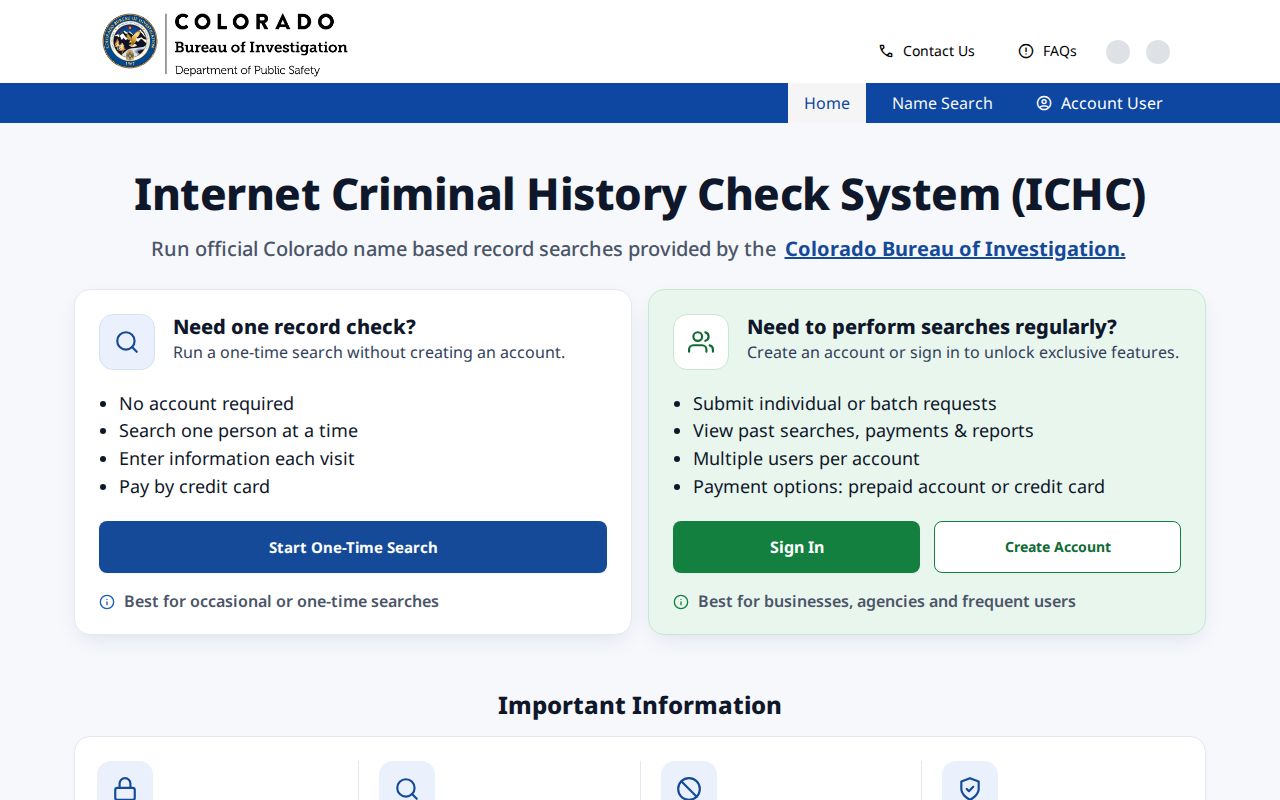
Use CBI for a statewide history and the filing court for the underlying complaint, orders, and count-by-count result. Each ICHC match viewed costs $6, and a common name can produce several possible matches.
Federal dockets sit outside the Colorado Judicial Branch. The official U.S. District Court for the District of Colorado serves all counties, with public case access through PACER.
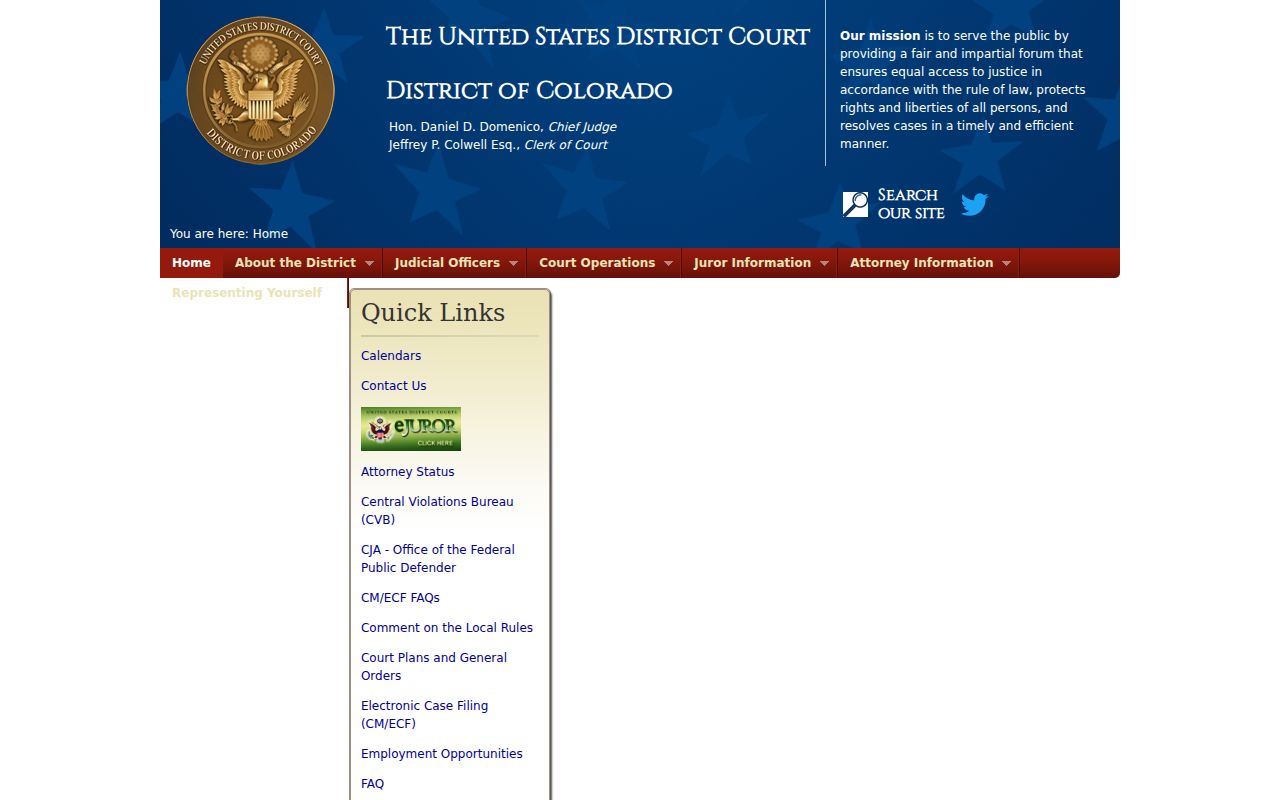
State Docket Search will not display a federal case merely because events occurred in Colorado.
Find Colorado Court Docket Offices
Use the Colorado county directory after the statewide search identifies the filing county. Each county has a state Clerk of Court, though the division, address, email, and counter vary. Give the clerk the full case number, party names, desired record, and whether a plain, certified, or exemplified copy is needed. A name search costs $5, so a known number saves time and money.
Older paper records may be stored offsite and carry actual retrieval cost. Historic files may have moved to the Colorado State Archives. For municipal matters, contact the city court named on the citation. If the county remains unknown, test reasonable dates and names in Docket Search, then use an approved register or narrowly contact plausible filing courts.
A focused request reduces delay. Ask for the register of actions first when the needed document title is unknown. The register can reveal the operative complaint, a later amended pleading, the date of a dispositive order, and whether an appeal or reopening followed. Then order only the identified papers. The statewide schedule lists copies at $0.25 per page, a $15 copy cap for parties and their attorneys, no page cap for nonparties, $20 per certified or exemplified document, and actual offsite retrieval cost. Research or redaction is $30 per hour in quarter-hour units after the first hour.
When access is limited, ask whether the Colorado docket is sealed, excluded by category, courthouse-only, archived, or releasable with redaction or proof of authority. Juvenile, adoption, mental-health, protected-address, victim, and financial information can require special handling. A party, attorney, parent, guardian, subject, or person with a court order may have rights the public lacks. The clerk may require government-issued identification.