
Colorado Court System Overview
The Colorado Supreme Court stands at the top. One statewide Colorado Court of Appeals reviews most final District Court judgments in three-judge panels. District Courts exercise general trial jurisdiction in 23 judicial districts. County Courts sit in all 64 counties and hear limited civil, misdemeanor, traffic, eviction, small-claims, protection-order, and early felony matters. Municipal Courts are created and funded by cities, so they remain outside the state Judicial Branch.
Seven Water Court divisions are parts of District Court but are organized by river basin rather than county lines. Denver is another major exception. Its constitutionally separate District, Juvenile, Probate, and County Courts do not follow the ordinary combined courthouse model. Colorado has one high court and no separate high criminal court. The Court of Appeals is also one statewide court, not a set of numbered geographic appellate districts.
Ordinary appeals path: Municipal or County Court › District Court › Colorado Court of Appeals › Colorado Supreme Court.
| Level | Court | Core jurisdiction | Number in Colorado |
|---|---|---|---|
| Last resort | Colorado Supreme Court | Final state review, rules, attorney regulation, specified direct appeals | 1 court, 7 justices |
| Intermediate appeal | Colorado Court of Appeals | Most final District Court, Denver Probate/Juvenile, and agency appeals | 1 statewide court |
| General trial | District Courts | Felony, unlimited civil, domestic, probate, juvenile, mental health | 23 judicial districts |
| Specialized trial | Water Courts | Exclusive water-right determination and administration | 7 basin divisions |
| Limited state trial | County Courts | Civil through $25,000, misdemeanor, traffic, eviction, small claims | 1 in each of 64 counties |
| Local trial | Municipal Courts | City ordinance violations | Varies by municipality |
Colorado Supreme Court Review
The Colorado Supreme Court is the final state tribunal. Its seven justices supervise the branch, regulate law practice and procedure, decide original proceedings within their authority, and review Court of Appeals decisions mainly through discretionary certiorari. A certiorari petition asks the court to take the case. Acceptance is not automatic. Supreme Court rulings bind Colorado's lower state courts.
Some designated matters go directly to the Supreme Court. Water Court judgments are the leading structural example. Certain constitutional and election matters can also use a direct path. A federal question may later reach the U.S. Supreme Court, but that is not another tier of the Colorado Judicial Branch.
Colorado Court of Appeals
The Colorado Court of Appeals is one intermediate court serving the entire state. It sits in three-judge panels and is not divided into geographic appellate districts. It reviews most final District Court judgments in civil, criminal, and domestic matters, decisions of the special Denver Probate and Juvenile Courts, and designated administrative-agency rulings. Its decision remains final unless the Supreme Court accepts review.
An appeal is not a new trial. Appellate judges examine the preserved record for legal error, which can include pleadings, admitted exhibits, signed orders, and a designated transcript. They do not simply rehear witnesses. Interlocutory review before final judgment is limited, and each route depends on rule or statute.
Statewide court: Do not look for a county's appellate district. Save the trial case number and follow the statewide Court of Appeals record.
Colorado District Court Jurisdiction
District Courts are Colorado's general-jurisdiction trial courts. They hear felony prosecutions, civil claims in any amount, divorce and domestic relations, juvenile dependency and delinquency, probate, mental-health matters, and appeals from County or Municipal Court. The state is divided into 23 judicial districts. A multi-county district may share judges and administrators, but a case file remains with the Clerk of Court in the county where it was filed.
A felony shows how court levels interact. A complaint can begin in County Court for advisement, bond, and a preliminary stage. After bind-over or the filing of an information or indictment, the District Court case carries the merits, pleas, trial, judgment, and sentence. An unlimited civil complaint, divorce petition, probate petition, or dependency case begins in District Court.
The 23rd Judicial District became operational on January 14, 2025. Douglas, Elbert, and Lincoln Counties moved into the new district, while Arapahoe County remained as the reconfigured 18th. Older maps may show 22 districts, so current court routing should follow the live Judicial Branch district directory.
Colorado Water Court Divisions
Colorado's seven Water Court divisions exercise exclusive authority over determining, using, and administering water rights. Each division follows a river basin, not ordinary county boundaries. A District Court judge serves as water judge, while a referee investigates applications. Monthly resumes publish applications so an affected person can file a timely statement of opposition.
The official Colorado Water Courts source pictured below lists the divisions, basin coverage, contacts, rules, and resumes.
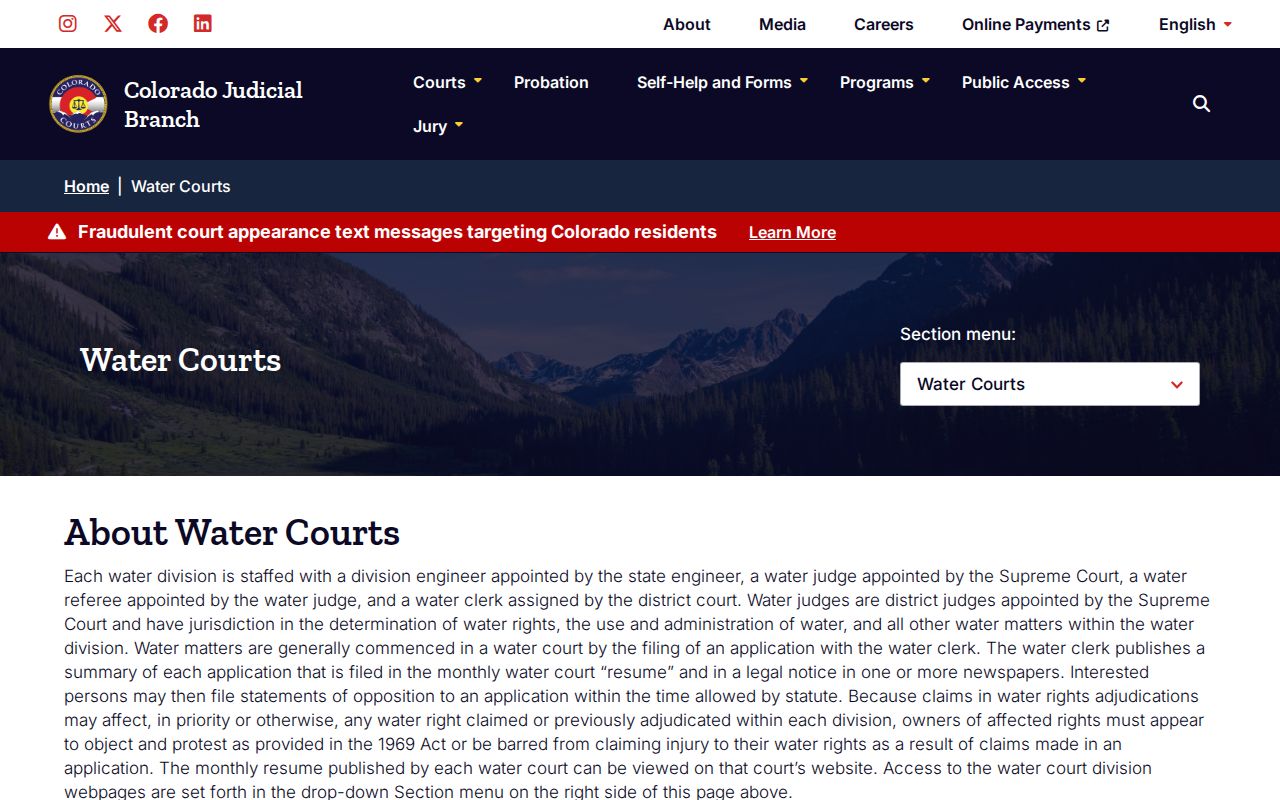
The basin structure and direct Supreme Court appeal route make Water Courts distinct from ordinary District Court divisions.
Water appeal path: Water Court › Colorado Supreme Court.
Colorado County and Municipal Courts
County Courts exist in each Colorado county. They hear civil claims through $25,000, evictions, misdemeanors, state traffic infractions, protection orders, small claims, and the complaint, advisement, or preliminary stages of a felony. Appeals generally go to District Court. Small Claims is a simplified division of County Court, not a separate justice court. Colorado does not use a Justice of the Peace court level in this hierarchy.
Municipal Courts enforce city ordinances, commonly local traffic, parking, nuisance, shoplifting, animal, and minor-offense provisions. A summons naming a city court is not interchangeable with a state County Court ticket. City cases may be absent from Colorado's statewide docket tools because municipal courts are outside the state Judicial Branch. Search and payment must go to the municipality printed on the citation.
| Question | District Court | County Court | Municipal Court |
|---|---|---|---|
| Civil reach | Any amount | Through $25,000, including evictions and small claims | City ordinance remedies |
| Criminal reach | Felony merits | Misdemeanors and early felony stages | Municipal offenses |
| Family and probate | Yes | No ordinary jurisdiction | No |
| Next appeal | Court of Appeals, subject to exceptions | District Court | District Court |
| Record custodian | Filing county Clerk of Court | Filing county Clerk of Court | City court clerk |
Colorado's Separate Trial Courts
Denver's Second Judicial District is not the standard combined state trial court. The constitution separates Denver District Court, Denver Juvenile Court, Denver Probate Court, and Denver County Court. Subject matter also affects location and contact. A researcher must read the caption and court name rather than send every request to one generic Denver clerk.
The official Denver court overview shows this four-court arrangement.
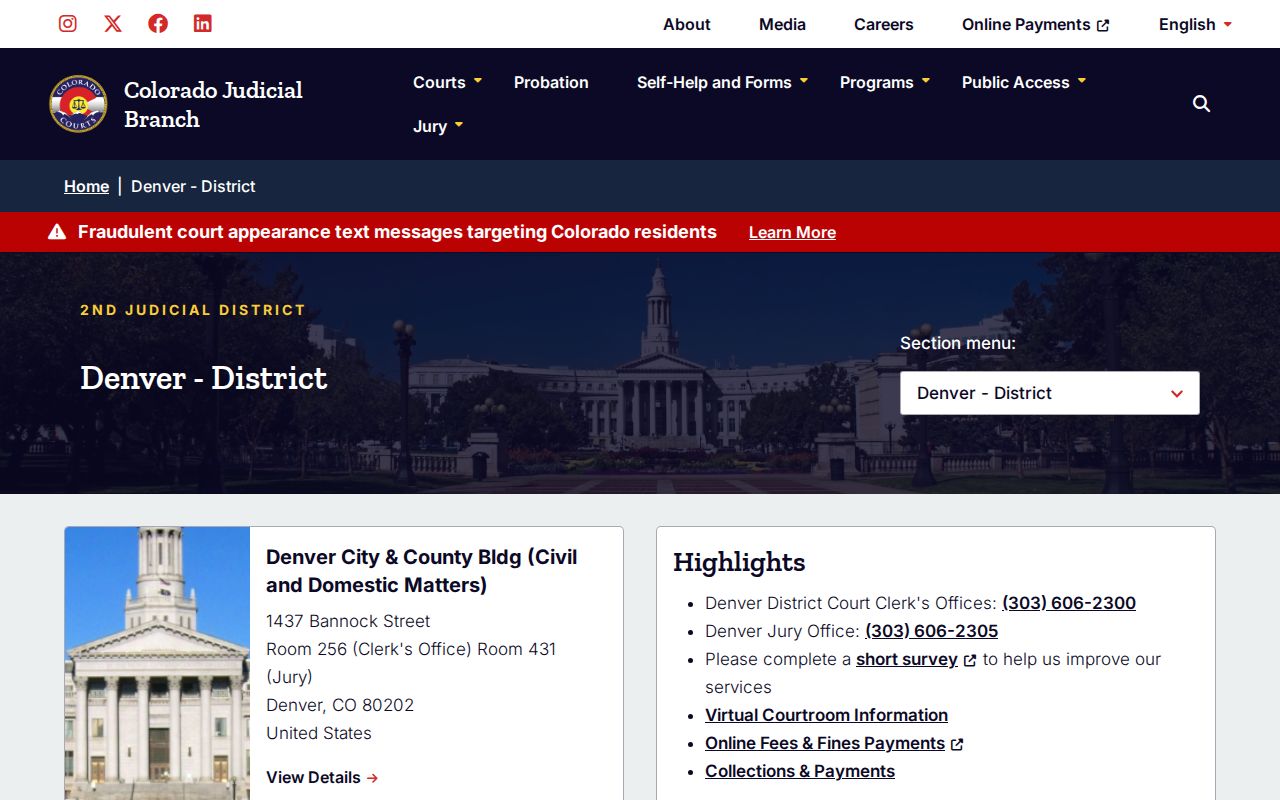
The separate courts affect filing, clerk contacts, searches, and the appeal route even though all serve one city and county.
Denver Probate and Juvenile Court decisions generally go to the statewide Court of Appeals. Denver County Court is locally funded and structured differently from ordinary state-funded County Courts. The distinctions matter for record requests, not just for hearing locations.
Colorado Court Appeals Paths
The initiating paper sets the starting court. A state traffic citation, misdemeanor, eviction, or limited civil claim normally starts in County Court. A city summons starts in Municipal Court. A felony may start with County Court advisement before its District Court merits case. Unlimited civil, divorce, probate, juvenile, and felony merits cases belong in District Court.
Criminal flow: County Court advisement › District Court charging and trial › Colorado Court of Appeals › discretionary Supreme Court review.
Civil flow: Complaint or petition › response and pretrial work › trial and judgment › Court of Appeals › discretionary Supreme Court review.
Problem-solving courts, including drug, DUI, veterans treatment, mental-health, and family-treatment dockets, remain programs within an underlying District or County Court. Availability and eligibility differ by judicial district. They do not create a separate statewide record repository.
Federal Courts Serving Colorado
Colorado forms one federal judicial district. The U.S. District Court for the District of Colorado hears federal criminal, civil-rights, federal-statute, constitutional, diversity, and other federal cases. The U.S. Bankruptcy Court for the District of Colorado handles bankruptcy. Appeals from the federal district court go to the U.S. Court of Appeals for the Tenth Circuit.
The official Tenth Circuit source is shown below.
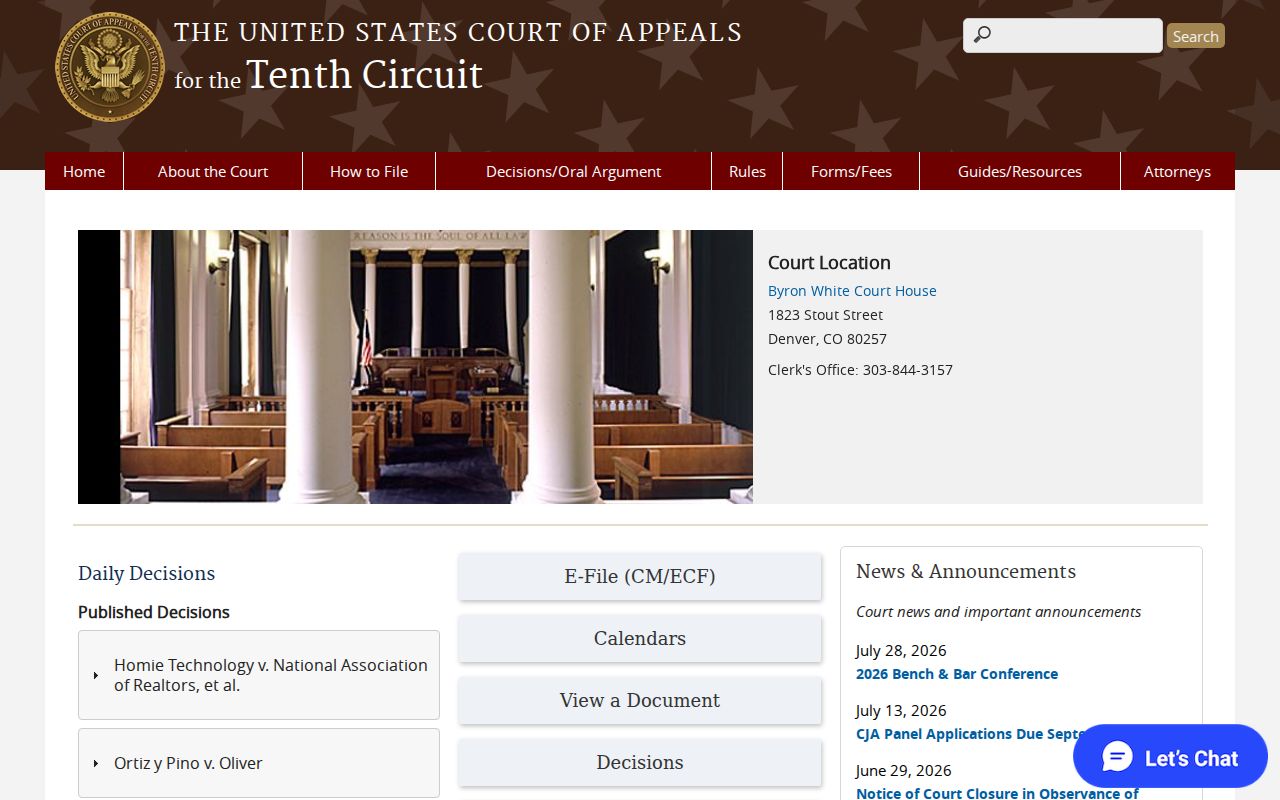
The Tenth Circuit is federal and must not be confused with Colorado's single statewide Court of Appeals.
Federal records use PACER or the federal clerk. They do not appear in Colorado Docket Search merely because the events occurred in the state. PACER generally charges by page, subject to its cap, quarterly waiver threshold, and current exemptions. State divorce, probate, and ordinary state charges remain in Colorado courts.
Colorado Court System History
Article VI of the Colorado Constitution grounds state judicial power. A 1966 constitutional revision substantially shaped the modern unified Judicial Department, central administration, and merit-selection and retention framework. The Court of Appeals appeared in the territorial era, was recreated in 1891, abolished in 1905, and restored in modern form in 1969 and 1970 as caseload grew.
The Water Right Determination and Administration Act of 1969 organized seven basin divisions. This remains one of Colorado's most distinctive court structures. Electronic filing and paid real-time registers later changed access, but did not create a free statewide document repository. Official pleadings and orders still come from the filing clerk.
Find Colorado Trial Court Records
Trial records follow the filing court and county, not a party's current home. Use the directory of all 64 Colorado counties to reach the correct Clerk of Court, then confirm whether the case is District, County, or municipal. A statewide docket result is useful scheduling data, but the clerk provides the official register and document copies.
Save the complete case number, location, party spelling, court type, and hearing information before contacting the clerk. For a city ordinance matter, use the named municipal court. For Water Court, appellate, or federal records, follow that specialized court's own source.